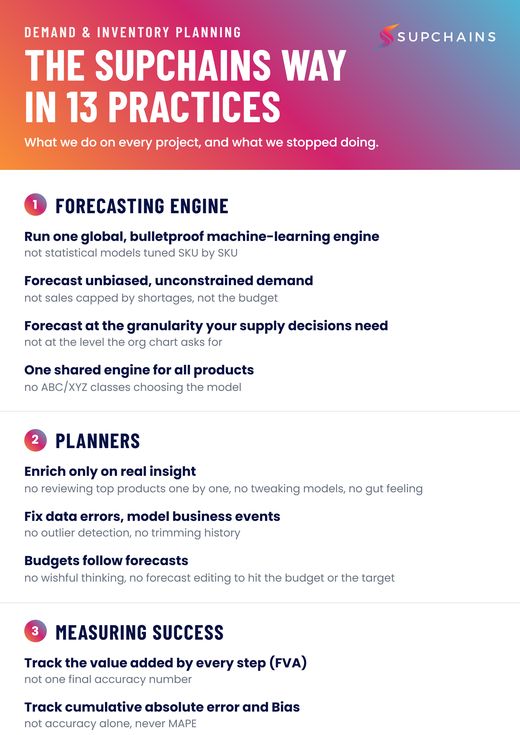
The SupChains Way

Over the years, we developed our own way of doing demand and inventory planning. It is what we apply on every client project, and it is how the winning teams of the VN1 and VN2 competitions work too.

  • 13 practices
  • 16 articles
  • 7 infographics
  • 1 AI-ready file

After a quick robot check, the download page opens. We also email you free chapters of our latest book, Demand Forecasting Best Practices. Then comes one lesson on demand planning every two weeks, and a few invitations a year to our webinars. Read our privacy policy.

The SupChains Way in 13 practices

What we do on every project, and what we stopped doing.

At its core: let a robust, global machine-learning engine do the mechanical forecasting work, ask planners to bring the information the engine cannot see, measure the value added at every step, and optimize inventory policies by simulation rather than trusting a formula.

1Forecasting Engine

  1. Run one global, bulletproof machine-learning enginenot statistical models tuned SKU by SKU
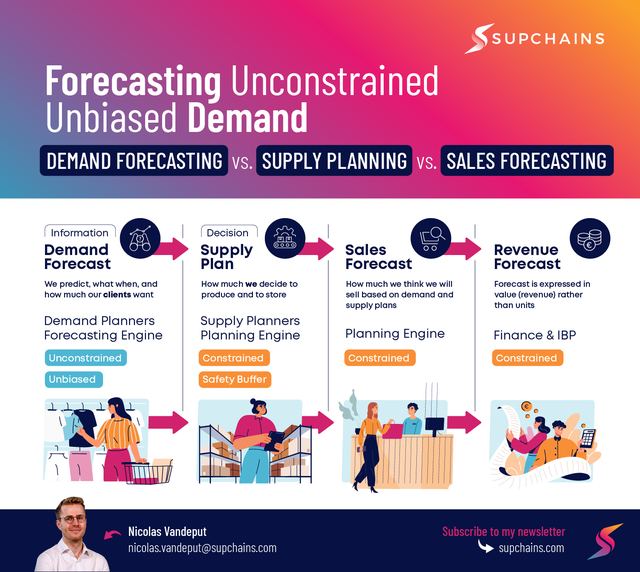
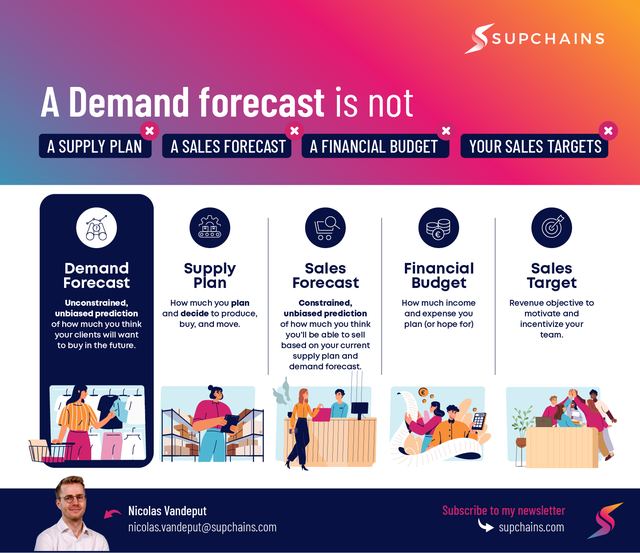
  2. Forecast unbiased, unconstrained demandnot sales capped by shortages, not the budget
  3. Forecast at the granularity your supply decisions neednot at the level the org chart asks for
  4. One shared engine for all productsno ABC/XYZ classes choosing the model
2Planners

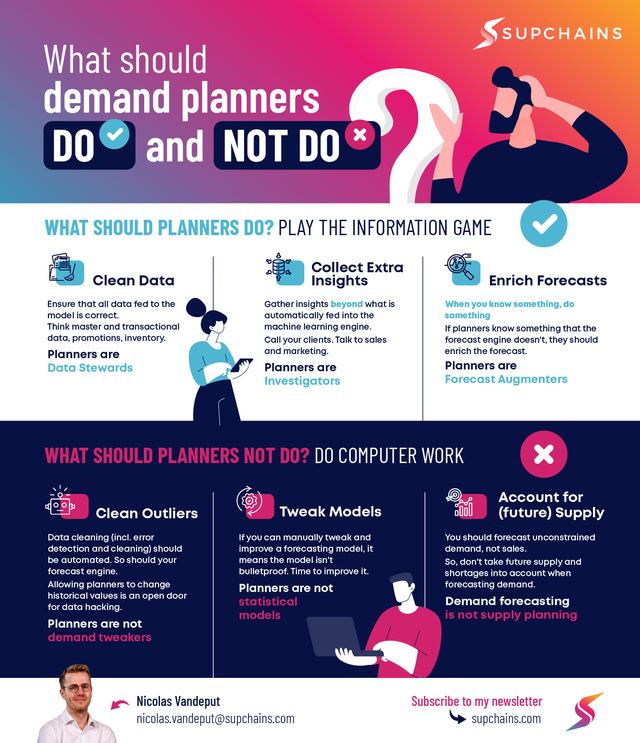
  1. Enrich only on real insightno reviewing top products one by one, no tweaking models, no gut feeling
  2. Fix data errors, model business eventsno outlier detection, no trimming history
  3. Budgets follow forecastsno wishful thinking, no forecast editing to hit the budget or the target

3Measuring success

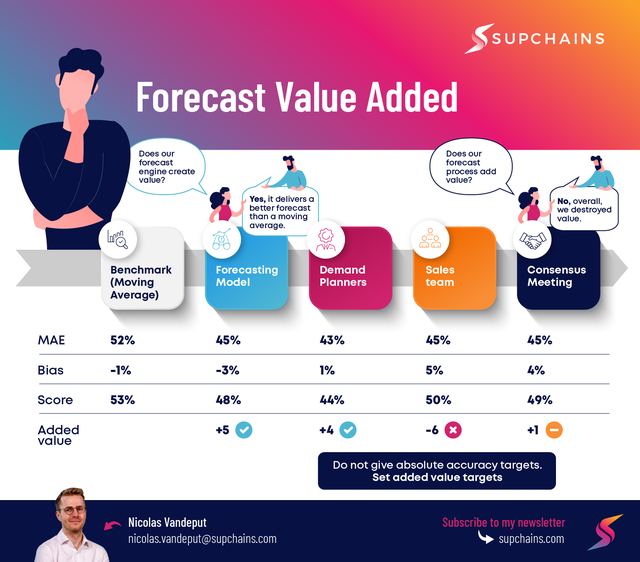
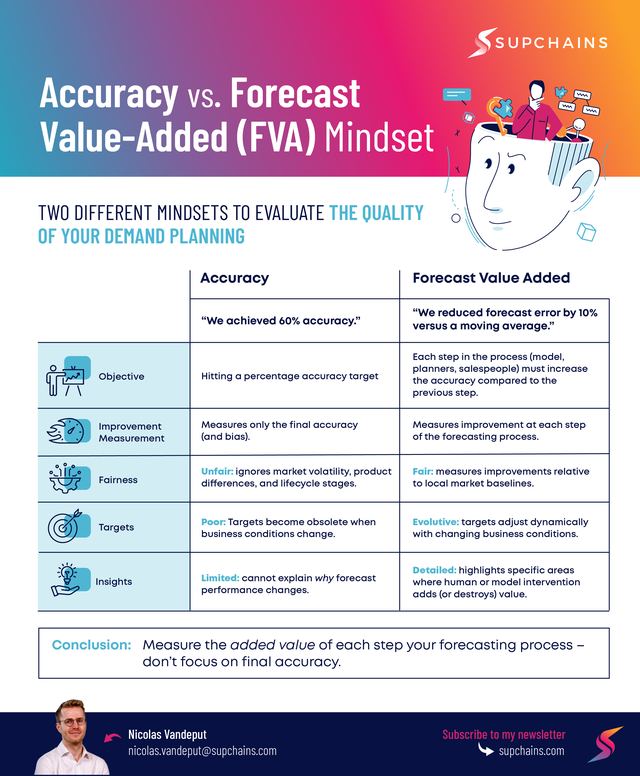
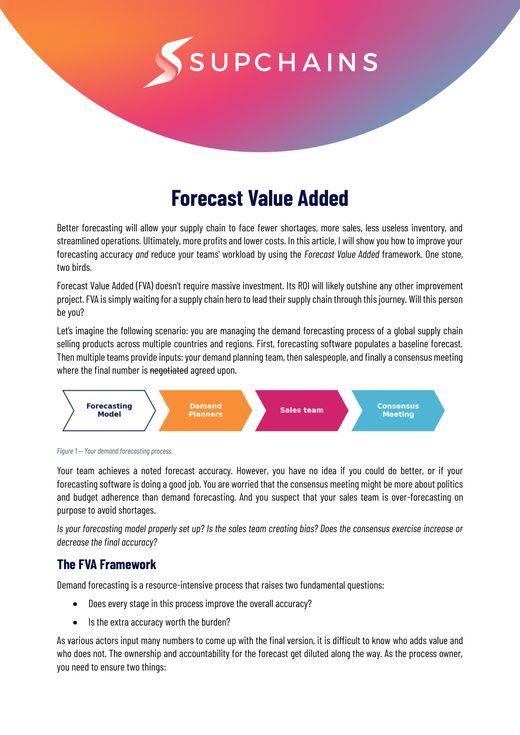
  1. Track the value added by every step (FVA)not one final accuracy number
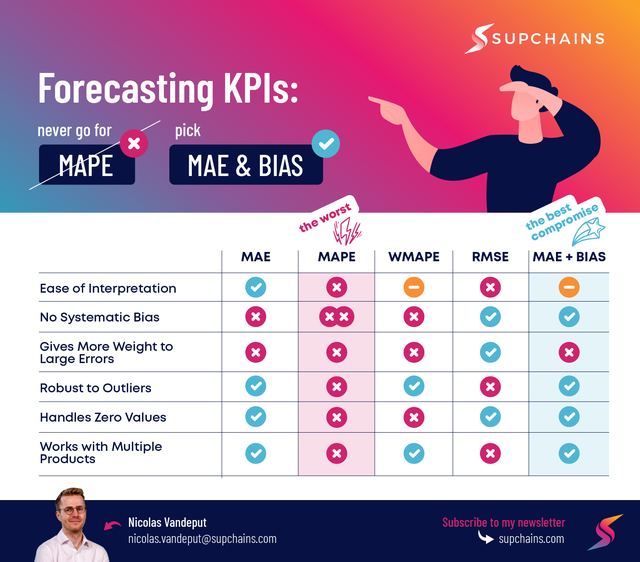
  2. Track cumulative absolute error and Biasnot accuracy alone, never MAPE
  3. Measure cumulative error over the risk horizonnot one arbitrary lag
  4. Compare your accuracy vs. a moving averagedo not focus on absolute accuracy, it is arbitrary

4Inventory Engine

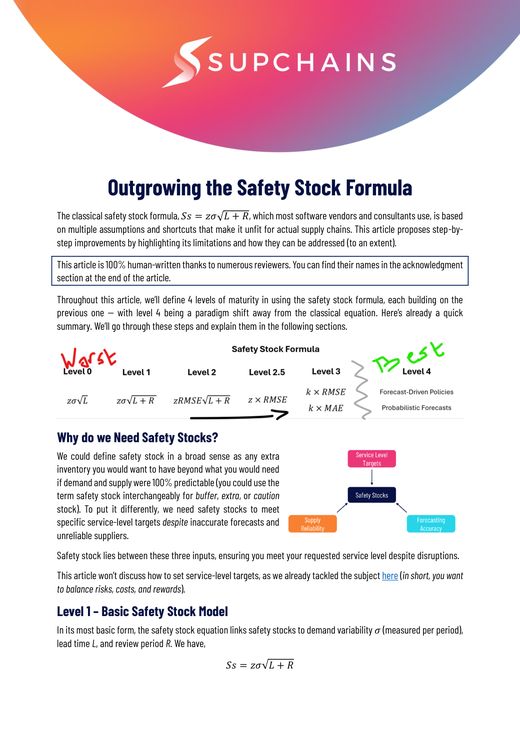
  1. Tune inventory targets by simulation on real demand and forecastsnot the textbook formula, not DDMRP
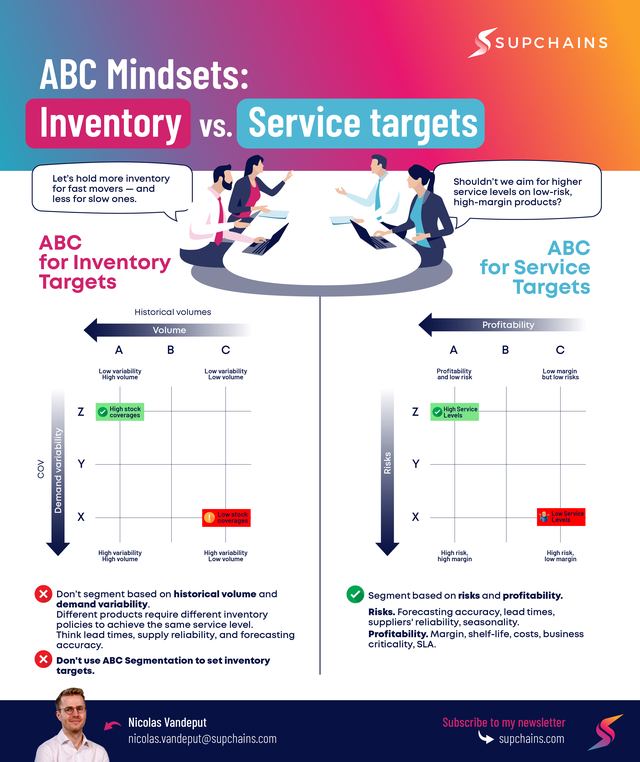
  2. Set service levels by strategy, cost and risknot by ABC class

The whole SupChains Way on one page: the 16 articles condensed, newest first. Read the full text

Seven infographics in the folder

The SupChains Way in pictures, one page per idea.

The whole method in 34 minutes

How to run an efficient demand planning process

Get the 16 articles behind these practices

The 16 articles as PDFs, the 7 infographics and an AI-ready text file to paste directly into ChatGPT or Claude to discuss your own planning processes.

After a quick robot check, the download page opens. We also email you free chapters of our latest book, Demand Forecasting Best Practices. Then comes one lesson on demand planning every two weeks, and a few invitations a year to our webinars.

Nicolas Vandeput speaking on stage

Want this applied to your supply chain?

SupChains delivers machine-learning demand forecasts and inventory optimization to manufacturers, distributors and retailers, and trains their planning teams. If your team is ready to change how it plans, let’s talk.

Forecasting modelsInventory modelsTraining