We reduce inventory by up to 20%
One simulation engine sets the stock target of every product at every site. It tests each policy on your own demand and forecasts before you change a single target.


















What clients measured
Thanks to SupChains and RitterDragon, Marzam could implement a new demand and inventory planning process. In 19 weeks, we improved inventory turns by 26% and reduced shortages by 65% while increasing our sales.
 Hector DoportoVP Supply Chain Planning, Marzam · pharmaceutical distribution
…he delivered both a tailored inventory optimization model and a machine-learning-based forecasting model for Bridgestone Europe, which resulted in considerable improvements from our previous projects.
Read the full quote
Nicolas makes sure he understands well the business context, so any solution is properly applied when it makes sense. He focuses on what can make the difference, not wasting time on buzzwords that do not bring any relevant improvement. This has been my experience working with him, where he delivered both a tailored inventory optimization model and a machine-learning-based forecasting model for Bridgestone Europe, which resulted in considerable improvements from our previous projects.
 Jon San AndresDirector Center of Excellence Supply Chain Planning, Bridgestone · automotive parts
He pedagogically helped us understand the fundamentals of effective demand and inventory planning and simplified these processes.
Read the full quote
Nicolas helped us improve our demand planning and inventory processes. He pedagogically helped us understand the fundamentals of effective demand and inventory planning and simplified these processes. We look forward to continuing our efforts to enhance our inventory strategy and forecast accuracy. We appreciate the good collaboration, fast responses, and Nicolas’ expertise.
 Christine SabataSupply Chain Manager, Camurus · pharmaceuticals
Your leaders set the service level. The engine optimizes inventory.
Your leadership sets a service-level target for each product group.
From the SupChains Way: set service levels by strategy, cost and risk, not by ABC class.
The engine tests several policies for every product and site.
It simulates each one on your past demand and forecasts, with your lead times, minimum order quantities and review periods. It keeps the policy that reaches the service level with the least stock.
Your planners rate the reliability of each supplier.
They get the targets, ready to enter in your planning software. They can see the orders to cancel or to expedite, and the stock of the coming months.
Better forecasts mean less stock and higher service. In our simulations, 10% better forecasts give 4% less inventory, or 6% fewer shortages. See the forecasting model
We don’t trust equations anymore.
Instead, we simulate.
Most software vendors and consultants use the classical safety-stock formula. It rests on assumptions that real supply chains break: every period behaves the same, and errors follow a normal curve.
Your supply chain has seasons, promotions, minimum order quantities and late suppliers. A simulation on your own history includes all of them.
 Read “Outgrowing the Safety Stock Formula”
Start with a proof of value
We build the engine for your products and sites, and test every policy on your past demand and forecasts.
2–3 months
To collect and clean your data with your team, set up the engine and test it on your history.
- What we need
Your demand and forecast history, the lead times of your suppliers and how reliable each one is.
Read the details
The engine also uses minimum order quantities, review periods and production calendars. Your leadership sets the service-level targets that the engine must reach.
- What you get
Optimized inventory policies that reach your service-level targets with the least stock.
Read the details
We simulate each policy on your own history, with your real demand and forecasts, your lead times, minimum order quantities and review periods. The simulation also accounts for the reliability of each supplier, late deliveries included.
- What sets the price
The number of products, the complexity of your data and the days on site.
- What comes next
A monthly service with support for your planners, or a licence.
Read the details
Every month, we run the engine, deliver the targets as a file for your planning software and review the exceptions with your planners. If you choose to buy a licence of our model, your team runs the engine.
Test it on your own numbers
Impact
We reduce inventory while keeping service level constant
- –Cash saved because of inventory reduction in m$
- –Savings thanks to inventory reduction in m$/year
- –Savings thanks to obsolete reduction in m$/year
- –Total savings in m$/year
in m$/year
Questions clients ask us
- Our data is not perfect.
- We start from the data you have and clean it with you. Then we simulate each policy on it before you change a single target.
- Do we need a new platform?
- The stock targets arrive as a file that you can load into your current planning software or ERP.
- We already pay for planning software.
- Great. It keeps running your orders, now with better targets from us.
- Who decides the service level?
- Your leadership does, for each product group. The engine optimizes your inventory to reach each target with the least stock.
- Our suppliers are often late.
- The simulation includes the reliability of each supplier, its lead times and its minimum order quantities.
- Do we need your forecast too?
- The engine needs historical and future forecasts for every product. Our monthly service includes demand forecasts.
- Do you implement software?
- We build and run our engine as a service. With a licence, your team runs it.
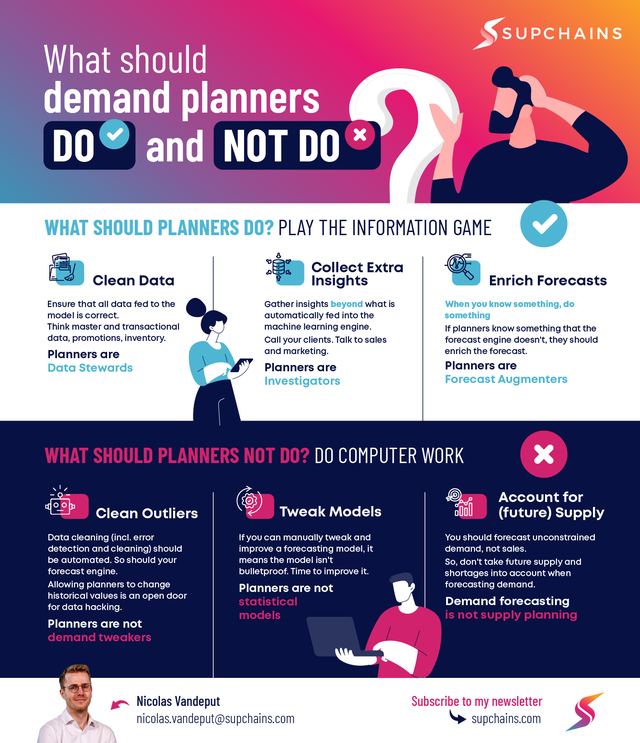
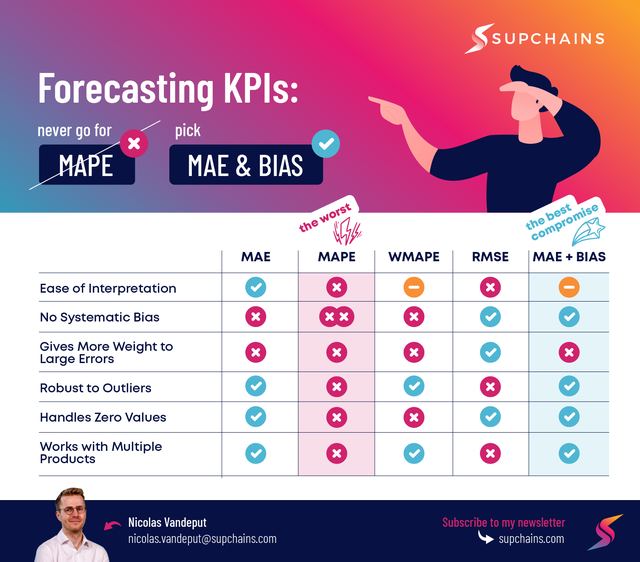
The SupChains Way
Our 13 demand and inventory planning practices
16 articles and 7 infographics, free to download
 Discover the SupChains Way